REVIEW · ORLANDO
Orlando Tree Trek Adventure Park
Book on Viator →Operated by Orlando Tree Trek · Bookable on Viator
If heights scare you, this is the test. Orlando Tree Trek turns a Disney-area day into real hands-on climbing with ropes, nets, ziplines, and swings up to 50 feet. I especially like the strong safety flow (waiver, harnessing, and a required demo) and the way the course ramps from beginner-friendly to tougher levels. The main drawback is that this is a physical challenge, so plan on a real workout, not just a quick thrill.
What makes it work for a mixed group is that there’s something for different comfort levels. You’ll climb through a series of obstacles suspended on poles in a pine forest, and if you’re not riding the course, you can watch from walking trails below. I also like that departures run every 30 minutes from 8:30 a.m., which helps you fit it around the rest of your Disney-area plans, especially when you start early to dodge the heat.
In This Review
- Key things to know before you climb
- Orlando Tree Trek adventure park: what this ropes course really is
- Location near Disney: timing, start times, and how to plan your day
- Safety briefing, waiver, harness fitting, and the demo course
- Courses in the trees: what you’ll climb, swing, and cross
- How high is high: understanding the 10 to 50 feet challenge
- Family fit: ages 7+, height reach rules, and the “follow along” option
- Pace, group size, and guide support: staying confident as you go
- What to wear and bring: shoes, jewelry rules, gloves, water, heat
- Price and value: why it’s worth your time (and when it might not)
- Should you book Orlando Tree Trek Adventure Park?
- FAQ
- How long does the Orlando Tree Trek adventure take?
- Where does the experience start and end?
- What age and height requirements are needed to participate?
- Do I need gloves, and are drinks included?
- What’s included in the ticket?
- Is the session group-limited?
- What should I wear?
- What if someone in our group doesn’t want to climb?
- What is the cancellation and weather policy?
Key things to know before you climb
- Safety comes first: waiver, harness fitting, then a mandatory demo course before you hit the trees
- Lots of variety: over 97 games across 6 courses, with swinging logs, cargo nets, bridges, zip lines, and trapeze swings
- A real height range: challenges sit about 10 to 50 feet (3 to 15 meters) above the ground
- Family-friendly, with rules: ages 7+ (with height/waist limits) and strict no-loose-clothing and no-jewelry guidance
- Limited group size: up to 15 travelers per session
- You’ll move at your pace: it’s designed for self-paced progress once you’re on the course, so groups can finish at different times
Orlando Tree Trek adventure park: what this ropes course really is
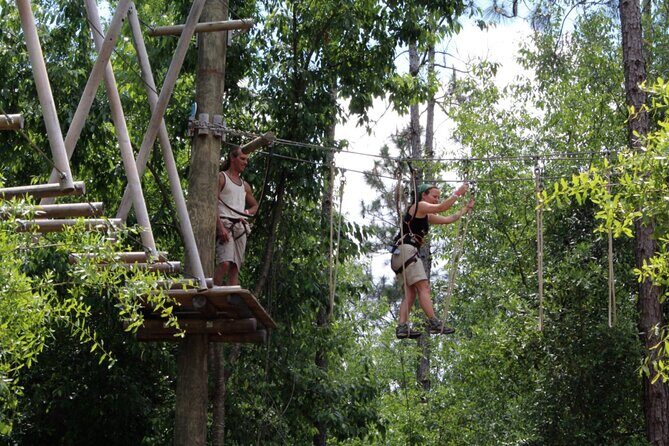
Orlando Tree Trek is not just a “zip line park.” It’s a climb-first aerial obstacle course. You’ll work your way across swinging and bridged elements like cargo nets, log-style crossings, and hanging sections, then earn zip lines along the route as you progress. The setting helps a lot: the whole course lives in a pine forest, so it feels like you’re doing something outdoorsy instead of moving from ride to ride.
The height matters here. Challenges start around 10 feet up and go as high as about 50 feet. That makes the experience feel meaningful. It’s high enough to be thrilling, but the course is still built as levels—so you’re not thrown straight into the deep end.
Most importantly for your planning: the experience is designed to take about 2–3 hours for the full course. That’s a sweet spot for an active half-day, especially if you’re already in the Walt Disney World area and want something totally different from theme parks.
You can also read our reviews of more tours and experiences in Orlando.

Location near Disney: timing, start times, and how to plan your day
The meeting point is at Orlando Tree Trek Adventure Park Zip Line, 7625 Sinclair Rd, Kissimmee, FL 34747. It’s close enough to Disney-area hotels that it’s often treated as a day-trip option, not a whole production of its own.
Sessions begin at 8:30 a.m. and run every 30 minutes through the last departure of the day. Since hours and timing can vary by season, you should confirm the exact slot you’re booked into before you leave your hotel.
Here’s the practical advice that makes a difference: start earlier rather than later. One of the most common real-world tips is that it gets hot, and you’re doing continuous body work while suspended above the ground. If you can choose, the morning slot tends to feel more comfortable for most people, especially families.
Transportation-wise, it’s described as near public transportation. If you’re driving, you’ll want to plan for a simple arrival routine so you’re not rushing during waiver time and harness fitting.
Safety briefing, waiver, harness fitting, and the demo course
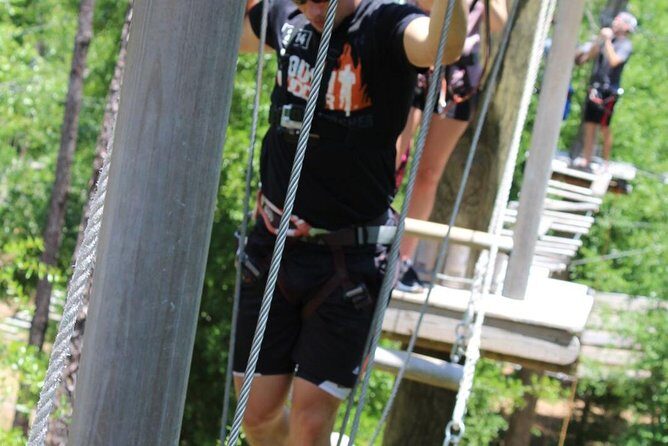
Before you ever climb, you’ll do the adult stuff: waiver, gear, and instruction. Your arrival flow is straightforward and designed to set you up for safe movement:
- Complete a required waiver form
- Get harnessed
- Take a mandatory demo course so you learn how the equipment and movements work
- Then you’re sent to your first course
That demo step is where a lot of the value lives. Even if you’re fearless, you still need to understand how the harness and connection points behave. And if you’re nervous, the demo helps you build confidence before you’re 20–40 feet up.
Staff guidance matters here. The experience is staffed with instructors who keep the focus on safety and technique. In past visits, guides such as Ryan have been praised for being thorough and even funny, and others like Josiah and Nick have been noted for being well-spoken and supportive. Even when you’re trying to go fast, you’ll still benefit from slowing down during the instruction.
Also, pay attention to the rules that sound strict because they’re strict for a reason:
- No open-toed shoes
- No loose clothing
- No jewelry
- Tie hair back
These aren’t optional. They help prevent loose items from catching on gear or ropes while you’re moving.
Courses in the trees: what you’ll climb, swing, and cross
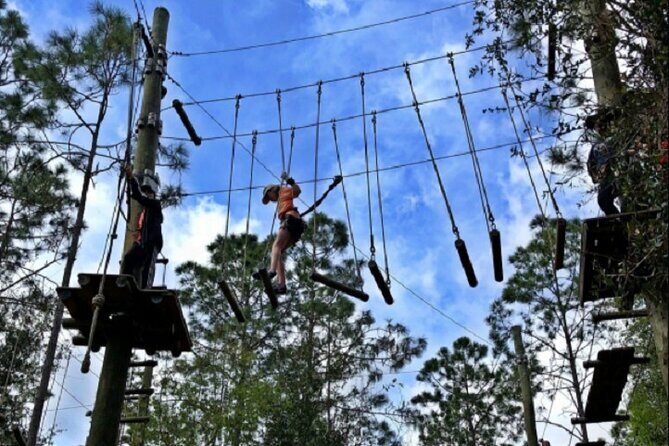
Orlando Tree Trek is built as 6 courses with over 97 games. The obstacles are suspended on poles in the trees, and the games are designed as a progression. You’ll bounce between types of movement:
- Cargo nets and climbable net sections
- Swinging logs and bridge-style crossings
- Bridges that test balance and confidence
- Zip lines as rewards at points in the route
- Trapeze swings and other dynamic elements
- Even skateboard-like segments show up depending on the level you’re on
This mix is a big reason the experience scores well. A pure zip line outing can start to feel repetitive. Here, you’re switching skills: grip strength, foot placement, balance, and controlled movement. Some levels feel like a puzzle—figure out how to hold, move, and shift weight without rushing.
A few real-world notes you can use:
- You should expect levels to get progressively harder as you go. One person described the route as escalating until the Red level felt like a true challenge.
- Some sections can be unavailable due to maintenance. One couple noted a few courses were out of service but most of the area stayed open. Build flexibility into your expectations.
And timing is part of the fun. You’ll complete the route step by step, and there may be moments where you wait briefly for the next section to open or for the guide to reset/prepare a zip line. That’s normal in structured aerial courses where safety checks happen between riders.
How high is high: understanding the 10 to 50 feet challenge
The park’s aerial range is about 10 to 50 feet (3 to 15 meters). That number is useful, but it doesn’t tell you how it feels until you’re there. The key is that the course uses height as intensity, not just spectacle.
If you’ve done climbing before, you’ll notice the challenge is partly technical. If you haven’t, the difficulty may show up as quickly as your grip strength or your ability to stay balanced while tired. Several people have called it physically challenging and not for the faint of heart, even while still praising how safe the setup feels.
If you’re in the “I have fear of heights” category, you’re not alone. Multiple guests reported managing the whole course despite height anxiety. That doesn’t mean it’s easy—it means the course design and the harness system let many people push past the fear with the right instruction and pacing.
A good mindset: treat each obstacle as a short mission, not a whole marathon. When you focus on the next element, you keep momentum and reduce the mental spiral.


Family fit: ages 7+, height reach rules, and the “follow along” option
This is described as a thrill for the whole family, with a minimum age of 7 years old. But there are also strict body measurements that determine participation, and you should check these before you drive over.
From the posted requirements:
- 44-inch waist or smaller
- Height reach requirements:
- Children: 4’7″
- Youth: 5’9″
- Adult/Seniors: 5’11”
The practical reason for these limits is simple: the harness connection and gear fit have to work for safe climbing. If someone is close to a cutoff, it’s worth double-checking with the staff before you assume they can go on the course.
If you don’t want to participate, you can follow along on walking trails below. That’s useful for:
- younger kids who are too short/young
- adults who aren’t feeling up to it that day
- anyone who wants to watch and cheer
One more family reality: groups may not finish together. Since the route is set up with guidance and safety steps, but movement can be self-paced, you might end up waiting for a slower member at certain transitions. Planning for that makes the experience feel smoother instead of frustrating.
Pace, group size, and guide support: staying confident as you go
Your session has a maximum of 15 travelers, which is a comfortable size for safety and attention without turning into a giant crowd. The guides are active during instruction and when gear and safety checks are needed.
Once you’re on the course, you’re responsible for your own pace. That’s part of the charm—this isn’t a ride where you sit back and hope. You actively choose your steps and grip. But it can also mean that you’ll want to watch your energy level. If you go too fast at the start, later obstacles feel tougher.
If you’re with teens and adults, the course can work surprisingly well because everyone can push at their limit. Some people said adult levels could feel a bit less intense than they expected, while others found it challenging enough to surprise them. That spread is normal for ropes courses: your baseline fitness and grip strength matter a lot.
What helps most is taking breaks between obstacles. Even short pauses help with breathing and re-centering your balance. And don’t be shy about asking for coaching if you get stuck. The staff is there for safety, and guests repeatedly described the team as attentive and kind.
What to wear and bring: shoes, jewelry rules, gloves, water, heat
This part decides whether you enjoy the day or spend it annoyed by discomfort.
Wear:
- closed-toe, secure shoes (no open-toed footwear)
- clothing that doesn’t snag (avoid loose items)
- tied-back hair
- no jewelry
Don’t count on:
- extra gear being provided beyond what’s listed
- bringing your own gloves unless you plan to
The included items are climbing equipment plus the demo course. Gloves and drinks are not included. That’s a practical heads-up because gloves can make a big difference in grip comfort over multiple obstacles, and dehydration can sneak up when you’re active outdoors.
A few extra tips that have shown up in real-world experience:
- Bring water or plan to buy it there, because waiting until the end can feel brutal.
- If you’re going early morning or during peak insect hours, bug spray can help.
- If you can, wear a shirt you don’t mind getting scuffed. Rope courses are messy by nature.
Also, plan for a full-body day. This is a workout. If you arrive hungry, it can be harder to keep energy for the later obstacles. One common suggestion is to fill up before you come.
Price and value: why it’s worth your time (and when it might not)
Since no exact ticket price is provided here, I’ll judge value by what you get.
You’re paying for:
- climbing equipment
- a mandatory demo course
- a structured experience with multiple levels (6 courses, 97+ games)
- staff-run safety orientation
- zip lines mixed into a true obstacle progression
That’s strong value if your group wants a physical activity that feels like an accomplishment. People who loved it often talked about finishing the levels and pushing their body farther than expected. One family even described it as a great birthday outing for multiple ages.
It might not be the best fit if:
- you want mostly ziplines with minimal climbing
- your group isn’t comfortable with heights or active balance work
- you’re expecting an easy walk-through
For some adults, the route may feel more like climbing than pure thrill speed. For others, it’s exactly the right mix. The key is that this is built as an aerial obstacle course first, zip line delivery second.
Should you book Orlando Tree Trek Adventure Park?
Book it if you want an active, outdoorsy experience near Disney that’s built around real skills: gripping, balancing, and moving through obstacles at heights up to 50 feet. It’s also a great choice for families with kids age 7+ who meet the height/waist rules and who like the idea of earning zip line moments by completing climbs.
Skip it (or at least plan a different option) if your group can’t manage a physical challenge or if you’re not willing to follow strict clothing and jewelry rules for safety. And if heat is a big concern, choose an early start.
If you’re unsure, I’d treat the course as a confidence-building day. You’ll get harnessed, guided through a demo, and supported by staff—many people even complete the full route despite fear of heights.
FAQ
How long does the Orlando Tree Trek adventure take?
It typically takes about 2–3 hours to complete the entire course.
Where does the experience start and end?
It starts at Orlando Tree Trek Adventure Park Zip Line, 7625 Sinclair Rd, Kissimmee, FL 34747, USA, and ends back at the meeting point.
What age and height requirements are needed to participate?
The minimum age is 7 years old. Height reach requirements listed are 4’7″ for children, 5’9″ for youth, and 5’11” for adult/seniors. There is also a 44-inch waist or smaller requirement.
Do I need gloves, and are drinks included?
Climbing equipment and the demo course are included. Gloves and drinks are not included.
What’s included in the ticket?
You get climbing equipment and a mandatory demo course to learn the harness and sample the challenges.
Is the session group-limited?
Yes. The maximum group size is 15 travelers.
What should I wear?
You must not wear open-toed shoes, loose clothing, or jewelry. Hair must be tied back.
What if someone in our group doesn’t want to climb?
Guests who do not wish to participate can follow along on walking trails below.
What is the cancellation and weather policy?
You can cancel for a full refund up to 24 hours before the experience’s start time. The activity requires good weather, and if it’s canceled due to poor weather you’ll be offered a different date or a full refund.